
Bitcoin Trading Bot Risk Management: How to Control Risk in Automated Trading
Learn how risk management works in automated Bitcoin trading, including position sizing, drawdown control, stop-loss planning, exposure limits, and safer MT5 Expert Advisor testing.
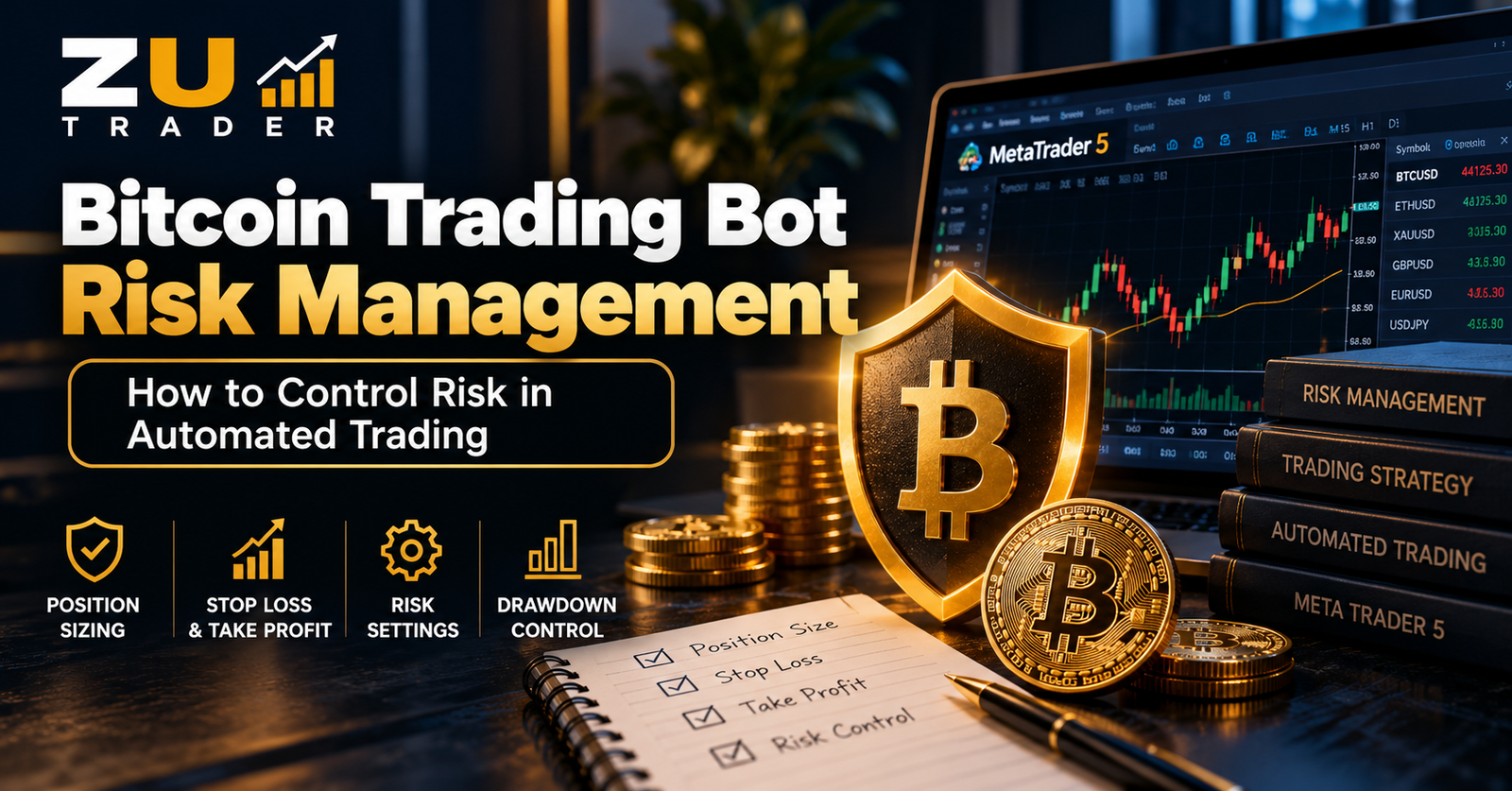
Automated Bitcoin trading can monitor markets and execute predefined strategies without requiring constant manual input. But automation does not remove trading risk.
In fact, one of the most important parts of using any Bitcoin trading bot is understanding how much risk the system can take, how positions are managed, and what happens when market conditions move against the strategy.
This guide explains the key principles of risk management for automated Bitcoin trading on MetaTrader 5 (MT5), including position sizing, drawdown, stop-loss rules, exposure limits, testing, and ongoing monitoring.
Why Risk Management Matters in Automated Bitcoin Trading
Bitcoin can experience rapid price movements and periods of increased volatility.
An automated trading system may respond faster than a human trader, but it still operates according to programmed rules. If those rules allow excessive exposure, large position sizes, or uncontrolled additional trades, automation can increase risk rather than reduce it.
Good risk management is therefore not about predicting every market movement.
It is about defining limits before unfavorable conditions occur.
A well-designed automated trading setup should make it clear:
- How position size is determined
- How many positions can be open
- How losses are managed
- Whether stop-loss rules are used
- How overall exposure is controlled
- What happens during drawdown
- When the strategy should stop opening additional trades
These controls are especially important in volatile markets such as Bitcoin.
1. Understand Position Sizing
Position sizing determines how large each trade is relative to the trading account.
Larger positions create greater exposure to both favorable and unfavorable price movements.
An automated trading system may use a fixed position size, a configurable position size, or a calculation based on account conditions and strategy rules.
Before using an Expert Advisor, understand how its position sizing works.
Important questions include:
- Does the EA use a fixed lot size?
- Can position size increase automatically?
- Can multiple positions be opened simultaneously?
- Does position size change after winning or losing trades?
- Is there a maximum position-size limit?
The objective should be to understand the exposure created by the strategy rather than simply selecting the largest available setting.
2. Understand Stop-Loss and Trade Exit Logic
A stop loss is one method of defining when a losing position should be closed.
However, automated systems can use different types of exit logic.
Depending on the strategy, an EA might use:
- Fixed stop-loss levels
- Dynamic stop-loss calculations
- Trailing stops
- Strategy-based exit conditions
- Take-profit targets
- Time-based exits
- Multiple conditions working together
It is important to understand the specific system being used.
A trading bot should not be assumed to have appropriate loss controls simply because it is automated.
3. Monitor Drawdown
Drawdown is an important measurement when evaluating an automated trading strategy.
It represents a decline from a previous account or strategy peak.
For example, a system can generate profitable periods while still experiencing significant declines between those periods.
This is why evaluating only total profit can provide an incomplete picture.
When reviewing an automated strategy, consider metrics such as:
- Maximum drawdown
- Relative drawdown
- Largest losing trade
- Consecutive losses
- Average winning trade
- Average losing trade
- Profit factor
- Number of trades
These measurements can provide more context about how a strategy behaved during testing.
Historical performance, however, cannot guarantee how the strategy will behave in future market conditions.
4. Control Multiple-Position Exposure
Some automated strategies can open more than one position.
This makes total exposure particularly important.
For example, several individually small positions can collectively create significant account exposure if they are all open in the same market direction.
Before using an automated strategy, understand:
- Maximum simultaneous positions
- Conditions for additional entries
- Whether new trades can be added to losing positions
- Whether position size changes between entries
- Total exposure limits
A system should be evaluated based on its combined exposure, not only the size of its first trade.
5. Avoid Assuming More Trades Mean Better Performance
A trading bot that opens many trades is not automatically better than one that trades less frequently.
Trade frequency depends on the strategy.
Some systems wait for specific market conditions, while others operate more frequently.
Increasing trading frequency can also increase:
- Transaction costs
- Spread exposure
- Slippage exposure
- Total market exposure
- The number of losing trades
The objective of automated trading should not simply be to maximize the number of trades.
The quality and risk characteristics of the strategy matter more than activity alone.
6. Use Demo Testing Before Considering Live Trading
A demo account can be useful for understanding how an Expert Advisor behaves without using real funds.
It can help verify:
- EA installation
- Broker compatibility
- Bitcoin symbol compatibility
- Position sizing
- Entry behavior
- Exit behavior
- Multiple-position behavior
- Trading frequency
- Platform stability
- Risk settings
Demo testing can also reveal configuration problems that may not be obvious from reading the EA settings.
However, demo execution and live execution can differ because of factors such as spreads, liquidity, slippage, and other trading conditions.
Demo results therefore should not be treated as guaranteed live results.
If you are new to MT5 automation, read our guide on How to Automate Bitcoin Trading on MT5 before configuring an automated system.
7. Use Backtesting as an Evaluation Tool
MetaTrader 5 includes a Strategy Tester that can be used to evaluate compatible Expert Advisors against historical data.
Backtesting can help examine:
- Historical trade frequency
- Drawdown
- Profit factor
- Winning and losing trades
- Position behavior
- Strategy responses during different market periods
It can also be useful for comparing different settings.
But backtesting has limitations.
Historical market conditions do not perfectly represent future conditions, and test results can be influenced by data quality, spreads, execution assumptions, and strategy configuration.
For this reason, backtesting should be viewed as an evaluation method rather than a prediction of future returns.
8. Be Careful With Aggressive Risk Settings
Many automated systems provide configurable risk options.
It can be tempting to increase these settings after seeing favorable backtest or demo results.
However, increasing risk can significantly change the behavior of the account.
Higher exposure can produce larger gains during favorable periods but can also increase losses and drawdown when market conditions move against the strategy.
Risk settings should therefore be evaluated according to the behavior of the complete strategy rather than expected profit alone.
9. Keep an Eye on Market Conditions
Automated trading strategies are generally designed around specific rules or market behaviors.
No single strategy is guaranteed to perform equally well in every environment.
Bitcoin can move through different conditions, including:
- Strong trends
- Sideways markets
- High volatility
- Lower volatility
- Sudden price movements
A strategy that behaves well in one environment may behave differently in another.
Regular monitoring can help identify whether current behavior is consistent with the intended strategy.
10. Monitor Your MT5 Environment
Risk management is not limited to trade settings.
Technical reliability also matters.
An automated trading setup can be affected by:
- Internet interruptions
- MT5 closing unexpectedly
- VPS downtime
- Broker connection problems
- Incorrect account settings
- EA configuration changes
- Software or platform updates
Check the platform periodically to make sure the EA remains active and the account is operating as expected.
For systems intended to run continuously, a reliable VPS can help keep MT5 online when a personal computer is unavailable.
11. Do Not Treat Automation as "Set and Forget"
One common misconception is that an automated trading bot can simply be installed and ignored indefinitely.
Automation can handle repetitive tasks, but account supervision remains important.
Periodically review:
- Open positions
- Closed trades
- Account balance
- Equity
- Drawdown
- EA status
- MT5 connectivity
- Risk settings
- Strategy behavior
Monitoring does not mean manually interfering with every trade. It means making sure the system is operating according to its intended configuration.
12. Evaluate Risk and Return Together
A large historical profit number by itself does not tell the complete story of a trading system.
Two strategies might produce similar returns while taking very different levels of risk.
When comparing automated systems, consider both performance and risk measurements.
For example, review:
- Net result
- Maximum drawdown
- Profit factor
- Largest loss
- Average win
- Average loss
- Number of trades
- Consecutive losses
This provides a more balanced view than looking at profit alone.
Risk Management and BTC Harvester
BTC Harvester is ZU Trader's automated Bitcoin trading system for MetaTrader 5.
The system is designed to automate Bitcoin market monitoring and trade management using its programmed trading engines and configurable controls.
Before using any automated strategy, users should understand its configuration, evaluate its behavior in a testing environment, and select settings appropriate for their intended use.
You can explore the available features, licensing options, and product information on the BTC Harvester – Automated Bitcoin Trading Bot for MT5 page.
A Practical Risk-Management Checklist
Before running an automated Bitcoin trading system, consider checking the following:
- Confirm the correct MT5 trading account.
- Confirm the correct Bitcoin symbol.
- Review the position-size setting.
- Understand how additional positions can be opened.
- Review stop-loss and exit behavior.
- Understand maximum exposure.
- Check drawdown behavior during testing.
- Test the EA on a demo account.
- Review historical tests carefully.
- Monitor MT5 connectivity and EA status.
The exact settings and controls available will depend on the Expert Advisor being used.
Final Thoughts
Risk management is one of the most important parts of automated Bitcoin trading.
Automation can help execute predefined trading rules consistently, but it cannot eliminate uncertainty, volatility, or the possibility of losses.
Understanding position sizing, total exposure, drawdown, trade-management rules, testing limitations, and technical reliability can help users evaluate an automated trading system more responsibly.
The goal should not simply be to find the highest historical return.
A more useful approach is to understand how a strategy attempts to generate results, how much risk it takes while doing so, and how it behaves when market conditions become unfavorable.
Automated trading involves financial risk, and no Expert Advisor, trading bot, backtest, or trading strategy can guarantee future profits.
Related Articles
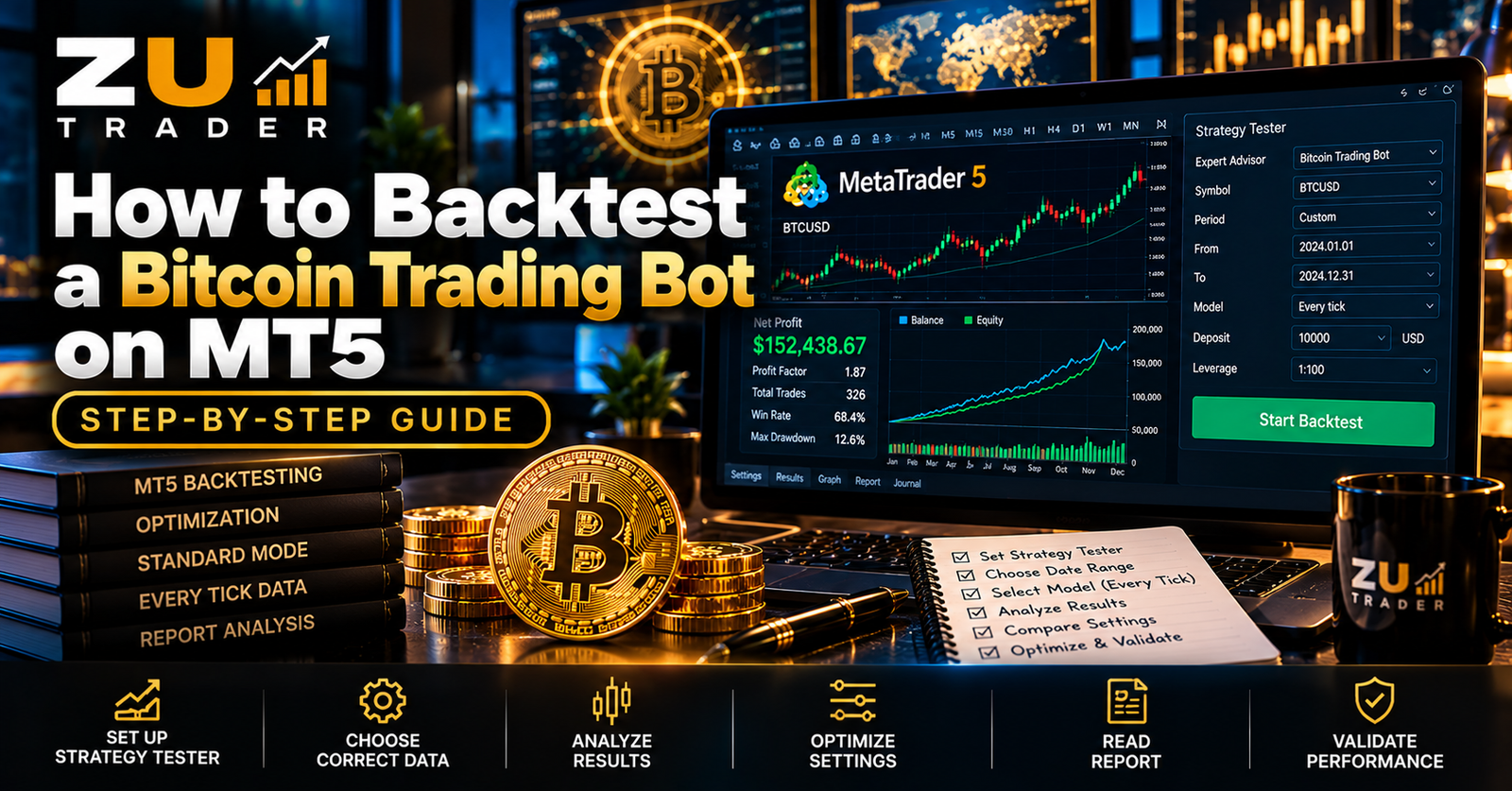
How to Backtest a Bitcoin Trading Bot on MT5: Step-by-Step Guide
Learn how to backtest a Bitcoin trading bot on MetaTrader 5 using the Strategy Tester, evaluate drawdown and profit factor, compare settings, and avoid common backtesting mistakes.
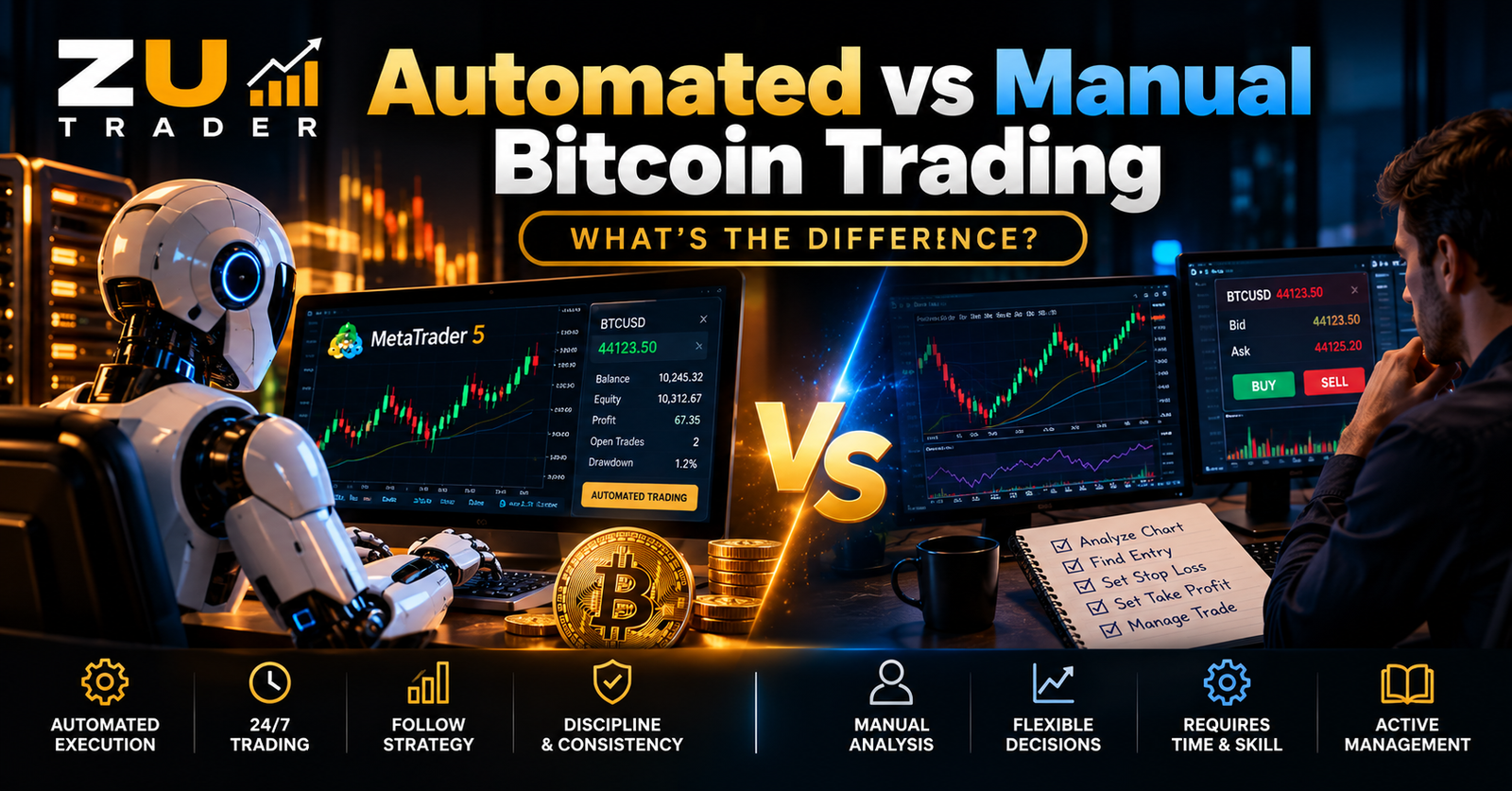
Automated vs Manual Bitcoin Trading: What’s the Difference?
Compare automated and manual Bitcoin trading, including how each approach handles market analysis, trade execution, risk management, time commitment, consistency, and MT5 trading.

How to Automate Bitcoin Trading on MT5: A Complete Guide
Learn how automated Bitcoin trading works on MetaTrader 5, how Expert Advisors execute trading strategies, and what to consider when choosing an MT5 Bitcoin trading bot.