
Gold Trading Risk Management: Tips for Automated Trading on MT5
Learn essential Gold trading risk management principles for MT5 automation, including position sizing, drawdown control, exposure limits, stop-loss logic, demo testing, and monitoring.
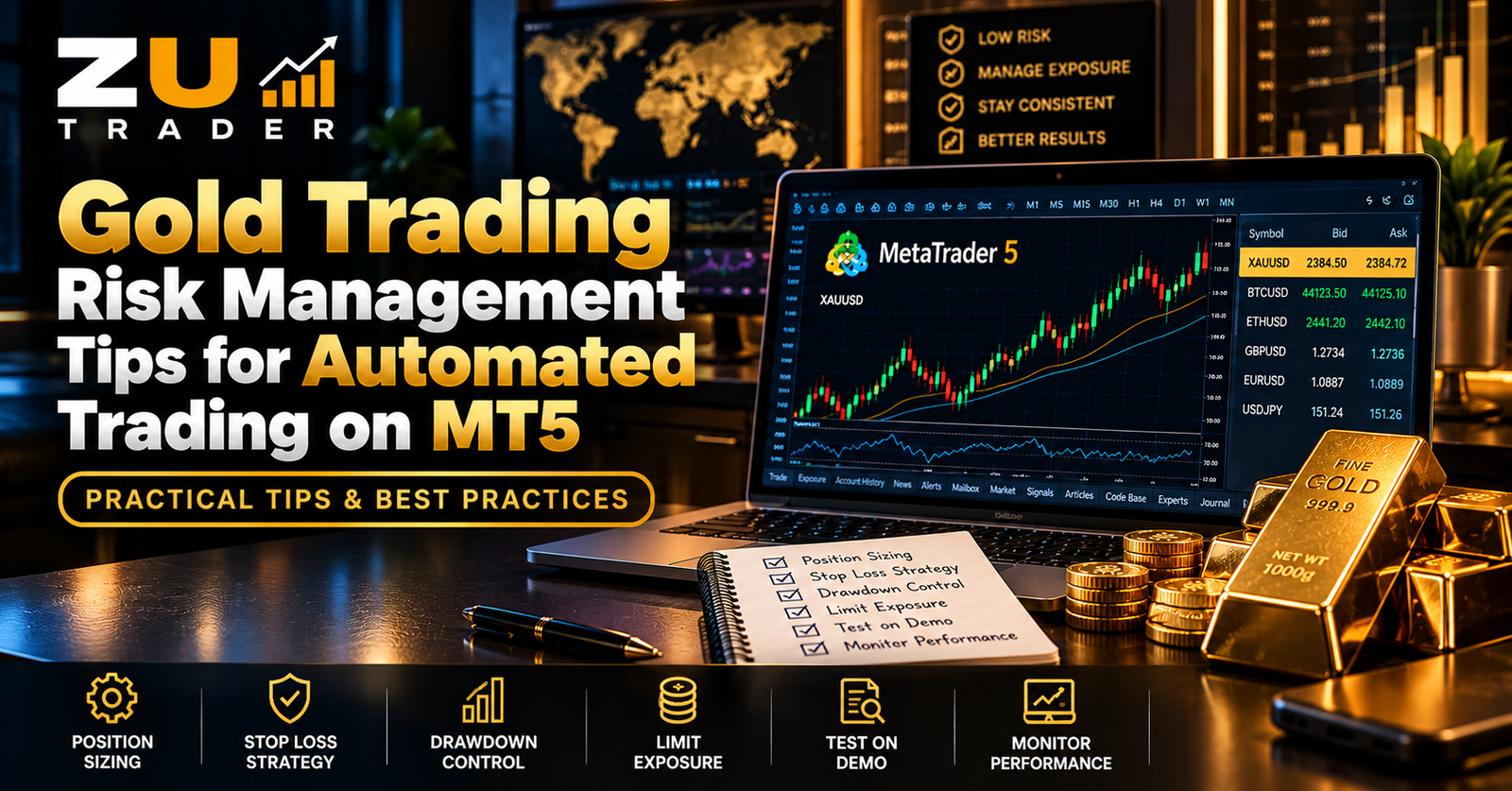
Gold can experience substantial price movements, which makes risk management an important part of both manual and automated XAUUSD trading.
An automated trading system can consistently execute predefined rules, but automation does not remove market risk. Position sizing, total exposure, drawdown, exit logic, and system monitoring can all affect how an automated strategy behaves when market conditions become unfavorable.
This guide explains important risk-management concepts to consider when evaluating or operating an automated Gold trading system on MetaTrader 5.
Why Risk Management Matters in Gold Trading
Gold can move differently under changing market conditions.
Periods of relatively stable price action can be followed by stronger volatility, and an automated strategy must operate within whatever conditions the market provides.
Risk management is designed to establish boundaries around that uncertainty.
A trading system may include rules related to:
- Position sizing
- Maximum open positions
- Stop-loss behavior
- Take-profit behavior
- Total market exposure
- Drawdown
- Entry restrictions
- Trading sessions
The exact controls depend on the Expert Advisor.
1. Understand Position Sizing
Position size determines how much market exposure an individual trade creates.
Larger positions generally produce larger changes in account value when price moves.
Before using a Gold EA, understand how its position sizing works.
Questions worth checking include:
- Is position size fixed or adjustable?
- Can the EA calculate position size automatically?
- Can position size increase between trades?
- Can several positions be open simultaneously?
- Is there a maximum size or exposure limit?
The goal is to understand the amount of exposure created by the complete strategy.
2. Consider Total Exposure
Looking only at the size of one position can be misleading if an automated system can open multiple trades.
For example, several positions in the same market direction may collectively create substantially more exposure than the first trade alone.
When evaluating a Gold trading bot, check:
- Maximum simultaneous positions
- Conditions for additional entries
- Whether new positions can be added while another position is losing
- Whether lot size changes between entries
- Whether the system limits total exposure
Total exposure is often more informative than examining a single trade in isolation.
3. Understand Stop-Loss Logic
Different Expert Advisors can manage losses differently.
Some may use a fixed stop loss, while others can use dynamic or strategy-based exit conditions.
Possible approaches include:
- Fixed stop loss
- Dynamic stop loss
- Trailing stop
- Break-even rules
- Strategy-based exit
- Time-based exit
Users should understand the specific logic of the system being used rather than assuming every automated strategy manages losses in the same way.
4. Monitor Drawdown
Drawdown measures a decline from a previous account or strategy peak.
It can provide useful context when evaluating risk.
A strategy may show a positive overall historical result while still experiencing significant declines during unfavorable periods.
When reviewing tests, consider measurements such as:
- Maximum drawdown
- Relative drawdown
- Largest losing trade
- Consecutive losses
- Average winning trade
- Average losing trade
- Profit factor
Looking at both performance and risk can provide a more balanced view of historical strategy behavior.
Historical results do not guarantee future performance.
5. Do Not Evaluate a Strategy by Profit Alone
A large backtest profit figure can attract attention, but it does not explain how much risk was taken to produce that result.
Two strategies could produce similar historical returns while experiencing very different drawdowns and exposure.
When comparing automated Gold strategies, examine more than the final balance.
Consider:
- Net result
- Drawdown
- Number of trades
- Largest loss
- Average loss
- Average win
- Profit factor
- Consecutive losses
- Total exposure
These measurements provide additional context about the strategy.
6. Be Careful With Aggressive Settings
Increasing position sizes or risk settings can significantly change how an automated system behaves.
A setting that increases potential gains can also increase potential losses.
This becomes particularly important when several positions can be open at the same time.
Avoid treating aggressive settings as a shortcut to better performance.
Any configuration should be evaluated based on both its potential return and its risk characteristics.
7. Test the Gold EA on Demo
A demo account can help users understand the behavior of an automated Gold strategy without using real funds.
Testing can help verify:
- XAUUSD compatibility
- Position sizing
- Entry frequency
- Exit behavior
- Additional-position behavior
- Risk controls
- Platform stability
- EA configuration
A demo environment does not perfectly reproduce live trading conditions, but it can reveal configuration and technical problems.
For the complete setup process, read How to Automate Gold Trading on MT5.
8. Use Backtesting Carefully
MetaTrader 5 provides a Strategy Tester for evaluating compatible Expert Advisors against historical market data.
Backtesting can help analyze how a strategy behaved during different historical periods.
However, results can be influenced by:
- Historical data quality
- Spread assumptions
- Trading costs
- Configuration
- Testing period
- Execution assumptions
Backtests should therefore be treated as analytical tools rather than promises of future performance.
9. Understand Gold Volatility
Gold can experience periods of increased volatility.
An automated strategy may behave differently when price movement becomes faster or wider than usual.
A system should therefore be evaluated across different market conditions rather than only during a particularly favorable period.
Possible environments include:
- Trending markets
- Sideways markets
- Higher volatility
- Lower volatility
- Rapid price movements
No single historical period represents every future market environment.
10. Avoid Unnecessary Overtrading
More trades do not automatically mean better results.
Increasing trade frequency can also increase:
- Market exposure
- Transaction costs
- Spread exposure
- Slippage exposure
- Number of losing trades
A strategy should trade according to its intended conditions rather than simply trying to remain active continuously.
11. Monitor the Trading Environment
Risk management also includes technical reliability.
An Expert Advisor depends on its trading environment.
Potential technical issues include:
- MT5 disconnecting
- Internet interruptions
- VPS downtime
- Incorrect broker server
- EA configuration problems
- Software updates
- Platform restarts
Periodically verify that the trading system remains in its expected operating state.
If continuous operation is required, see our MT5 VPS Setup Guide for Automated Trading.
12. Understand How Expert Advisors Make Decisions
Risk controls cannot be evaluated properly without understanding how the underlying EA works.
An Expert Advisor follows programmed conditions for analyzing markets and managing trades.
Different EAs can have completely different approaches to:
- Entries
- Exits
- Position management
- Additional trades
- Risk controls
Our guide How Expert Advisors Work on MetaTrader 5 explains the underlying process in more detail.
Automated vs Manual Risk Management
In manual trading, a person is responsible for applying risk rules consistently.
In automated trading, predefined rules can handle some of those decisions.
Automation can improve consistency of rule execution, but it cannot determine whether the original strategy or configuration is appropriate for future market conditions.
Human supervision therefore remains important.
A Practical Gold Trading Risk Checklist
Before operating an automated Gold strategy, consider checking:
- Confirm the correct XAUUSD or Gold symbol.
- Review position sizing.
- Understand maximum simultaneous positions.
- Understand additional-entry logic.
- Review stop-loss and exit behavior.
- Check total exposure.
- Evaluate historical drawdown.
- Test the system on demo.
- Verify MT5 connectivity.
- Monitor strategy behavior periodically.
ZU Trader and Automated Gold Trading
ZU Trader provides automated trading software designed for MetaTrader 5, including systems focused on Gold and Bitcoin markets.
When evaluating an automated Gold trading product, users should understand its intended market, strategy configuration, risk controls, technical requirements, and operating environment.
Risk management should remain part of the evaluation regardless of which automated trading system is being considered.
Final Thoughts
Automated Gold trading can provide consistent execution of predefined rules, but it cannot eliminate uncertainty or financial risk.
Position sizing, total exposure, drawdown, stop-loss logic, testing, and ongoing monitoring all contribute to responsible evaluation of an automated strategy.
Rather than focusing only on potential returns, consider how the system behaves when market conditions become unfavorable.
A balanced evaluation considers both performance and risk.
Automated trading involves financial risk. Expert Advisors, demo results, backtests, and historical performance cannot guarantee future results.
Related Articles
Best Trading Sessions for Gold (XAUUSD) on MT5: Timing and Volatility Explained
Learn how major trading sessions can affect Gold (XAUUSD) activity on MT5, including volatility, session overlaps, broker trading hours, and considerations for automated Gold trading.
Best MT5 Settings for Gold Trading: How to Configure a Gold EA
Learn how to configure MT5 settings for automated Gold trading, including timeframe selection, position sizing, risk controls, trading sessions, backtesting, and Gold EA optimization.
How to Automate Gold Trading on MT5: A Complete Guide
Learn how automated Gold trading works on MetaTrader 5, how Expert Advisors monitor XAUUSD, and what to consider when configuring, testing, and managing an MT5 Gold trading bot.